Why Restroom Access for Truck Drivers Should Not Still Be Up for Debate
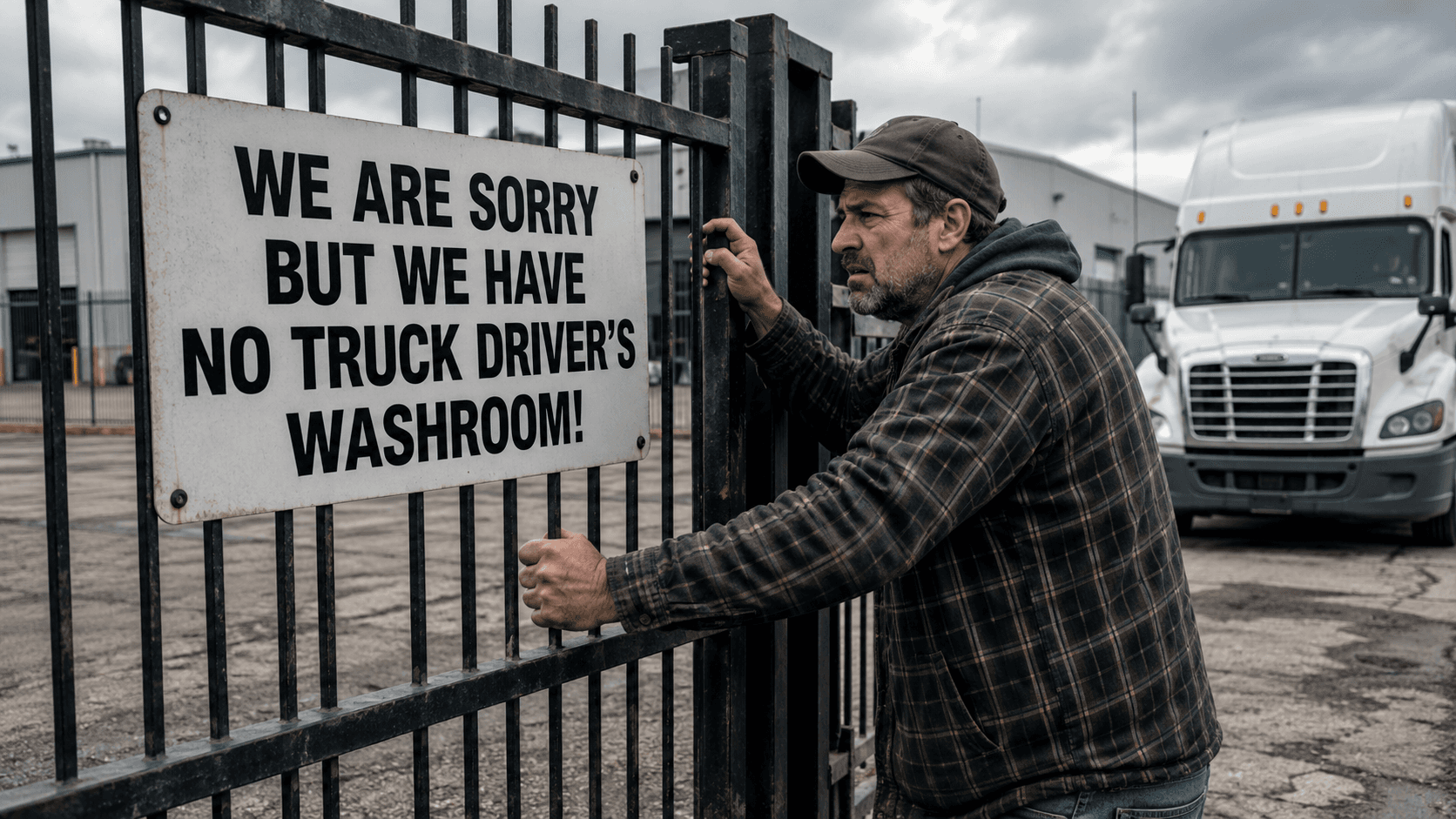
A recent article from The Drive reported that federal lawmakers are considering language that would require restroom access for truck drivers and drayage operators while they are delivering, waiting, or moving freight. The headline was intentionally provocative, and honestly, it needed to be. Because in 2026, the fact that professional drivers still need legislation to access a restroom tells us something much bigger about the system. America built a freight network around speed, volume, compliance, and cost, but too often failed to build around the humans who make that freight move.
I typically do not engage with clickbait. When I see a headline designed to drive emotion or provoke a reaction, I usually keep scrolling. But when I saw this one, I said, hallelujah. Not because the issue is new to me, but because maybe this is what it takes to make people pay attention to something that has been happening for decades.
I did not have to read the article to understand the problem. I did not have to guess. I know this experience. I have seen this experience firsthand. I have watched it go from bad to worse, even when I thought it could not get any worse. During the pandemic, many shippers and warehouses were given new justification to say, “We cannot let you in.” What had already been a difficult experience for drivers became even more restrictive, impersonal, and dehumanizing.
And over the years, I have heard every explanation for why this is justifiable.
I have heard that it is a security issue.
I have heard that it is a labor issue.
I have heard concerns about workers’ compensation, liability, facility policy, staffing, access control, and operational disruption.
I am not saying those concerns are always imaginary. In some environments, there are real constraints. Ports, warehouses, food facilities, secure yards, and industrial locations all have rules they must manage. But if those concerns are real, then the question becomes even more important:
Where was the intentional solution for the drivers?
Because the reality is, this problem continues to exist for two reasons. First, there is no easy line item for care, dignity, and treating people the way we would want to be treated. Second, when a human need falls outside the operating model, too many companies treat it as someone else’s problem.
That is how we got here.
For years, some warehouses had driver lounges, restrooms, waiting areas, vending machines, coffee, or a place where drivers could at least sit with dignity. Some still do. Some companies go out of their way to make drivers feel respected, welcomed, and treated like part of the operation. Those companies deserve credit.
But they are not the norm.
Too often, drivers are kept at a distance. No face-to-face contact. No food access. No restroom access. No comfortable place to wait. No real consideration for the long hours they spend sitting between appointment times, loading delays, unloading delays, detention, paperwork, and yard congestion.
Now imagine that same standard applied anywhere else.
Imagine showing up to work every day and being told you cannot use the restroom until you leave. Imagine waiting for hours at a facility that depends on your labor, but tells you that your basic needs are not their responsibility. Most of us would not tolerate that from an employer. Most of us would not tolerate it from a restaurant, a store, or a place where we spend money. We have all had the experience of walking into a business, asking to use the restroom, and being told, “Sorry, not for the public.” Even then, it feels dismissive.
But for drivers, this is not an occasional inconvenience. It is part of the job.
That is the part we have to confront.
This should not be reduced to politics. I understand the bill history matters. I understand the policy process matters. The Trucker Bathroom Access Act had previously been introduced as standalone legislation, and similar language is now included in a broader transportation bill. That context is important. But the larger issue is not about who gets credit, which party introduced it, or how the legislation is packaged.
The larger issue is whether we still know how to see people.
We have to stop seeing politics first and start seeing human care. Because when we focus only on who said it, who sponsored it, who opposed it, who attached it, or why it was included in a larger bill, we risk missing the simplest truth:
Human care should not be debatable.
Restroom access should not be controversial. Food access should not be treated as a luxury. Safe waiting areas should not be considered extra. Drivers should not have to depend on luck, kindness, or a sympathetic guard at the gate to meet basic human needs while doing essential work.
This is exactly why TAELORA exists.
TAELORA is not just about convenience. It is about access. It is about building mobile infrastructure for the places where traditional foodservice, retail, and hospitality do not reach. It is about serving the people who work, wait, move, and keep critical systems running, especially in environments where fixed infrastructure has failed to meet the need.
Because access is not just a food issue.
Access is not just a restroom issue.
Access is not just a driver issue.
Access is an infrastructure issue.
And if the people moving America’s freight still have to fight for the right to use a restroom in 2026, then the system is telling us something very clearly.
It was designed for movement.
It was designed for throughput.
It was designed for freight.
But it was not fully designed for the humans who carry it forward.
That has to change.
Read the original article:
Original source
Some articles continue on the original publication. Use this link when the full text is hosted externally.
Read original

For investor inquiries: invest@mytaelora.com
For general inquiries: tree@mytaelora.com
If you are an investor, strategic partner, media contact, or potential pilot collaborator, we welcome the conversation.
A private concept demo is available for investor review upon request.
Link later to: mailto: invest@mytaelora.com